
The Industry Portal: practical finance, treasury and banking courses, video breakdowns and a weekly newsletter for professionals.
The week in finance, without the noise
The top industry stories of the week, and the updates that matter, delivered straight to your inbox.
- Free forever
- One email a week
- Unsubscribe any time

Watch and learn
Hand picked sessions across Finance & Treasury, Innovation & Automation and Career Development.
Capital Management Explained: Bank Capital Ratios, ICAAP, and Basel III
What are capital ratios, ICAAP, stress tests, buffers, and AT1 instruments, and why are they so important in banking? In this video, we break down capital management explained, one of the most critical disciplines in modern banking.
Watch on YouTubeLiquidity Day 1: Why Liquidity Matters - The Banking Risk That Moves Fast
This session breaks down liquidity in simple, professional terms. We explore how banks meet their daily obligations, how maturity transformation creates structural vulnerability, and why liquidity risk moves faster than credit or market risk.
Watch on YouTubeIRRBB Explained: How Interest Rate Risk Impacts Banks | Treasury & Risk Management
What is Interest Rate Risk in the Banking Book (IRRBB) and why does it matter so much for banks today? In this video, we break down IRRBB explained in simple, practical terms. From real-world banking examples to global regulatory requirements.
Watch on YouTubeCourse catalogue
Courses from The Industry Portal and our specialist instructors. Explore all to filter by source, topic and level.
 Free
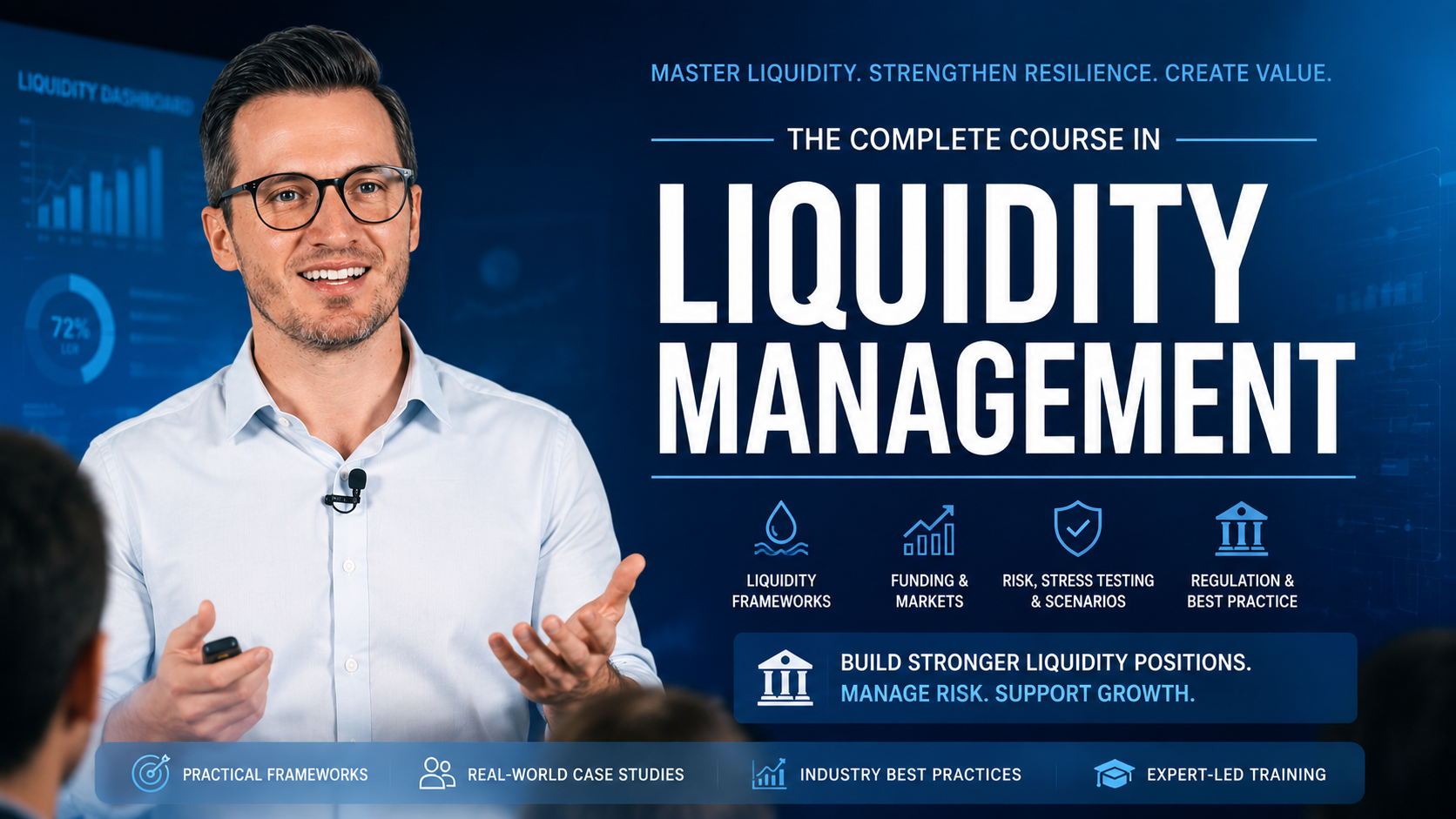
FreeLiquidity Management
The core building blocks of treasury: cash, liquidity, funding and the ratios regulators care about.
 Dean Taylor
 Youtube
Funds Transfer Pricing (FTP) Complete Course | Bank Treasury & ALM
Master Funds Transfer Pricing (FTP) with this complete, practical course designed for banking, Treasury, ALM, liquidity risk, finance and balance sheet management professionals.
 Free
FreeThe Complete Leadership Development Programme
In today’s rapidly changing business world, technical expertise alone is no longer enough.
 Dean Taylor
Top industry news
The finance, banking and treasury news that matters, and why it matters for you.

Traders Pile Back Into Treasury Short Positions as Bond Volatility Hits Six-Month High
After a brief short-covering rally prompted by weaker US jobs data, traders rapidly reloaded bearish positions on US government bonds in the first week of October 2026, signalling that the months-long selloff has further to run. A Bloomberg Markets Pulse survey found that more than half of 173 respondents expect 30-year Treasury yields to hit 6% before the end of the year. The 10-year yield reached levels not seen since 2007 and a gauge of bond price swings climbed to a six-month high. Bloomberg Opinion noted that US net interest payments now run at roughly $1 trillion a year, accounting for around half of what the government borrows, with the federal deficit already at approximately 6% of GDP.
Source: Bloomberg

FSB Final AI Sound Practices Report Due This Month as Cyber Risk Named Top Threat
The Financial Stability Board is set to publish its final report on 12 sound practices for responsible AI adoption by financial institutions in October 2026, a key deliverable to the US G20 presidency. In a letter to G20 finance ministers and central bank governors dated 31 August 2026, FSB Chair warned that frontier AI models' growing autonomy and offensive cyber capabilities make cyber risk the most immediate financial stability concern linked to AI. The sound practices framework covers materiality-based risk assessment, model governance, data quality, explainability, human oversight requirements that tighten as AI autonomy grows, and third-party AI risk management. Separately, HM Treasury in the UK confirmed it is gathering evidence for decisions on designating major AI and cloud providers as Critical Third Parties under the UK CTP regime.
Source: Banking News AI (citing FSB primary source)

US Treasury Yields Hit 24-Year Highs as Global Bond Selloff Deepens
Long-end US Treasury yields surged to levels not seen since 2002 in the first week of October 2026, with the 10-year touching 5.34% and the 30-year reaching 5.7%. Traders extended short positions against US government bonds even after a brief rally triggered by weaker-than-expected jobs data. BMO Global Asset Management's Earl Davis told Bloomberg that a 30-year yield above 6% is now 'inevitable' and likely to arrive within the month. Bond market volatility climbed to a six-month high as fiscal sustainability concerns, persistent inflation and a hawkish Fed backdrop combined to keep pressure on the long end.
Source: Bloomberg
Latest writing
Notes from practitioners across Finance & Treasury, Innovation & Automation and Career Development.

10 AI Skills Every Banking and Finance Professional Should Learn Before 2027
Two analysts, same job title, very different futures. Here is a concrete ten skill framework for banking and finance professionals who want to combine domain knowledge with practical AI and data capability before the gap widens further.

String Formatting with the format Method
The format method transforms messy string building into clean, readable templates that your colleagues can trust. Learn how to format numbers for financial reports, build reusable templates, and stop writing concatenation code.

Connect Your Database to Alteryx: Input Data Tool and SQL Queries Explained
Connect Alteryx directly to your database to pull data on demand, filter at source, and eliminate manual CSV exports. Learn to set up your connection, write efficient SQL queries, and build workflows that stay current.
Go further with a membership
Unlock the full courses, the community and early access. Start free and upgrade whenever you are ready.
From the shop
Official Industry Portal merch, printed to order and shipped worldwide.










What The Industry Portal is
The Industry Portal is a learning platform for finance, treasury and banking professionals. It brings together structured courses, long form video breakdowns, a weekly newsletter and a membership, so people can learn the parts of the industry that usually stay behind closed doors.
If you support our YouTube channel as a member, your membership is recognised here automatically. To do that, the application connects to the YouTube Data API to confirm your channel membership and unlock the member content you are entitled to. We only access the membership information needed for that check. You can read exactly what we collect and why in our Privacy Notice.